Astrocartography is a branch of astrology, also known as locational or relocation astrology, that maps how different locations on Earth affect your life based on your birth chart.
It uses your exact birth date, birth time, and birth city to project your natal chart onto a world map, creating what’s known as an astrocartography map.
Also known as relocation astrology, it shows where specific planetary energies become strongest for you, influencing areas like career, relationships, and emotional stability.
In simple terms, it answers one question:
Where in the world do you function best, and why?
Most people feel it before they understand it.
A city feels effortless. Another drains you. Astrocartography explains that pattern.
What Is Astrocartography in Simple Terms
Astrocartography takes your birth chart and projects it onto a world map.
Instead of planets sitting in houses, they become lines across the globe, showing where those planetary energies are most active in your life.
Each line represents a planet rising, setting, culminating, or at the base of the sky at the moment you were born.
That’s what creates the map.
These planetary lines, often called astrocartography lines or planet lines, show where specific energies from your natal chart become most active across the world.
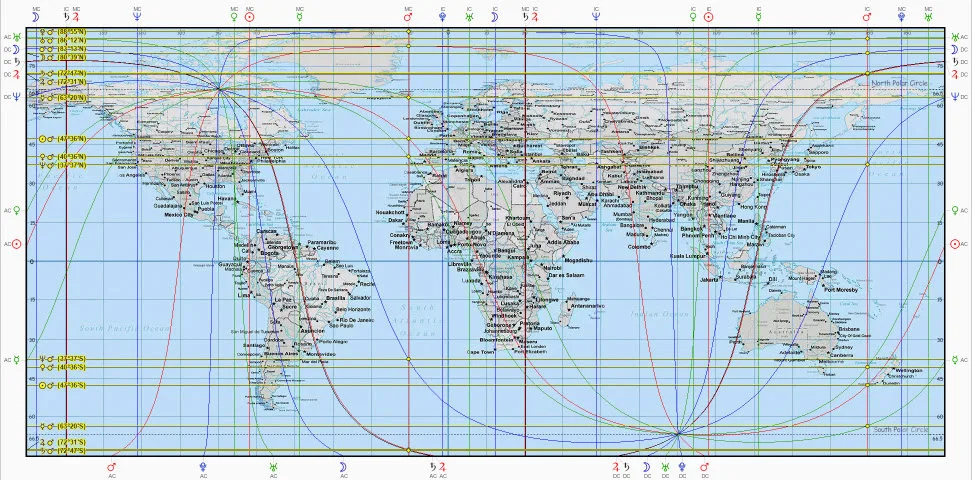
What an Astrocartography Map Shows
Your map shows planetary lines running north to south across the Earth.
Each line corresponds to a planet and an angle:
- Ascendant (AC) – identity and self
- Descendant (DC) – relationships
- Midheaven (MC) – career and visibility
- Imum Coeli (IC) – home and inner life
Where those lines fall geographically is where those themes become amplified.
Why Location Changes Your Experience
Your birth chart doesn’t change.
Your environment does.
Astrocartography works because location shifts how your chart is expressed.
You’re not becoming a different person.
You’re activating different parts of yourself depending on where you are.
How Astrocartography Works (Without Overcomplicating It)
At its core, astrocartography tracks where each planet was angular at your time of birth.
At the moment of your birth, each planet in your natal chart sits within angular houses, meaning it is rising, setting, at its highest point (MC), or at the Imum Coeli (IC). Astrocartography tracks where those positions repeat globally.
That’s it.
Those angular positions are projected onto a map as lines.
Planetary Lines Explained
Each planetary line carries a different type of experience:
- Sun lines: identity, confidence, recognition
- Moon lines: emotions, home, sensitivity
- Venus lines: relationships, attraction, ease
- Mars lines: action, conflict, drive
- Jupiter lines: growth, opportunity, expansion
- Saturn lines: pressure, discipline, responsibility
- Uranus lines: change, freedom, and upheaval
- Neptune lines: spirituality, imagination, and illusion
- Pluto lines: power, depth, and transformation
- Chiron lines: healing, wounding, and wisdom
- North Node lines: growth, direction, and destiny
These aren’t “good” or “bad.”
They’re environments that emphasise certain themes.
The Four Angles (AC, MC, DC, IC)
The same planet behaves differently depending on the angle:
- AC (Ascendant): how you show up
- MC (Midheaven): career and public life
- DC (Descendant): relationships and others
- IC (Imum Coeli): home, roots, inner world
A Venus AC line feels very different from a Venus MC line.
Same planet, different expression.
Why the Same Line Feels Different for Everyone
Your natal chart decides how you experience each line.
A strong Jupiter in your chart will feel supportive.
A challenged Saturn may feel heavy, even in a “good” location.
This is where most online advice falls apart.
They treat lines as universal. They’re not.
This is why your astrocartography chart isn’t random. It’s a precise projection of your own chart across the world, showing where different planetary lines fall and where lines can intersect or overlap.
What Astrocartography Can Tell You
This is where it becomes useful.
Astrocartography isn’t theory. It’s applied.
Where You Thrive vs Where You Struggle
Some places naturally support you. Others don’t.
You might feel:
- energised and visible in one location
- stuck or overlooked in another
The map explains why.
Career, Relationships, and Lifestyle Shifts
Different locations highlight different areas of life:
- MC lines push career and visibility
- DC lines bring relationship focus
- IC lines pull you inward toward home and stability
You don’t get everything everywhere.
Location forces emphasis.
Why Some Places Feel “Right” Instantly
That immediate sense of alignment or discomfort isn’t random.
It’s usually tied to a planetary line interacting with your chart.
Astrocartography gives language to something you’ve already experienced.
The Most Important Astrocartography Lines (Quick Guide)
This page is the overview. Each line has its own flavour, and each one should link through to a full standalone page.
Sun Line – Identity and Direction
Sun lines tend to amplify confidence, visibility, vitality, and self-expression. These locations can feel like places where you are more fully seen, more recognised, and more able to step into your purpose.
Moon Line – Emotional Life and Inner Experience
Moon lines heighten emotional sensitivity, intuition, memory, and attachment. These places often feel deeply familiar, nurturing, or overwhelming, depending on your relationship to emotional security and home.
Mercury Line – Communication and Movement
Mercury lines emphasise learning, conversation, networking, mobility, writing, teaching, and mental stimulation. Life here can feel busy, curious, and full of activity, but not always restful.
Venus Line – Love, Attraction, and Ease
Venus lines are often associated with connection, beauty, pleasure, sociability, and harmony. These places can support romance, creativity, and enjoyment, but they can also encourage complacency if everything becomes too comfortable.
Mars Line – Drive, Action, and Friction
Mars lines increase motivation, urgency, courage, and physical energy. They can be productive and energising, but they can also bring impatience, conflict, heat, and pressure if the energy has nowhere useful to go.
Jupiter Line – Growth and Opportunity
Jupiter lines tend to bring expansion, optimism, opportunity, perspective, and momentum. These places can feel bigger, more generous, and more open, though excess, overconfidence, or unrealistic expectations can also show up.
Saturn Line – Discipline and Responsibility
Saturn lines bring structure, realism, commitment, maturity, and long-term building. These locations can feel heavy, demanding, or isolating at first, but they often support serious growth, mastery, and endurance.
Uranus Line – Change, Freedom, and Upheaval
Uranus lines disrupt routine and push for liberation, reinvention, and independence. These places can feel exciting, electric, and awakening, but they can also bring instability, unpredictability, and sudden change.
Neptune Line – Spirituality, Imagination, and Illusion
Neptune lines can heighten intuition, sensitivity, inspiration, and spiritual or creative openness. They may feel magical or transcendent, but they can also blur boundaries, distort reality, and create confusion or projection.
Pluto Line – Power, Depth, and Transformation
Pluto lines intensify everything. These locations often bring deep internal change, power struggles, endings, rebirth, obsession, and psychological excavation. They are rarely light, but they can be life-changing.
Chiron Line – Healing, Wounding, and Wisdom
Chiron lines tend to expose old pain, vulnerabilities, and unresolved patterns, often in ways that eventually lead to healing, teaching, or deeper self-understanding. These places can feel raw, meaningful, and strangely necessary.
North Node Line – Growth, Direction, and Destiny
North Node lines often feel significant, future-facing, and karmically charged. These locations can pull you toward growth, unfamiliar opportunities, and life directions that stretch you beyond your comfort zone.
How to Read an Astrocartography Map (Basic Framework)
Most people look at the map and guess. That’s the mistake.
There is a process.
Step 1: Find Your Current Location
Start with where you are now.
Look at which lines are nearby (usually within ~200–300km).
Step 2: Identify Your Closest Lines
Focus on the planets influencing that area.
Ignore distant lines. They matter less.
Step 3: Combine Planet + Angle
Don’t read the planet alone.
A Venus line on the MC ≠ a Venus line on the IC.
The angle changes the outcome.
Step 4: Avoid Common Mistakes
- Don’t label lines as purely good or bad
- Don’t ignore your natal chart
- Don’t assume one location fixes everything
This is where most DIY interpretations break down.
For a full breakdown, you need a structured astrocartography reading.
What Happens When Astrocartography Lines Intersect
When two lines intersect, the energy of both planets combines.
These line intersections can feel intense, fast-moving, or even life changing, depending on the planets involved. For example, a Venus and Jupiter intersection may amplify relationships and opportunity, while a Mars and Saturn intersection can feel like pressure combined with resistance.
These areas are often where major shifts happen, but they’re rarely simple.
Why Most People Get Astrocartography Wrong
The internet has simplified this too much.
Thinking in “Good vs Bad” Lines
There are no universally good locations.
A Mars line isn’t “bad.” It’s intense.
A Venus line isn’t always “perfect.” It can make you passive.
Context matters.
Ignoring the Natal Chart
Your birth chart determines how you experience each location.
Without it, you’re guessing.
Copying Generic Advice Online
“Move to your Jupiter line” sounds good.
It’s also lazy advice.
Your chart might not respond well to that at all.
Should You Use Astrocartography to Decide Where to Live?
Yes, but not blindly.
When It Works Well
- when you’re choosing between locations
- when you feel stuck and need a shift
- when patterns repeat across places
When It Doesn’t
- when you expect one location to solve everything
- when you ignore real-world factors
- when you oversimplify the map
What You Actually Need for Accuracy
You need:
- your full birth chart
- correct interpretation of lines + angles
- context for your current life stage
Without that, you’re working with fragments.

Get a Professional Astrocartography Reading
You can generate a free astrocartography map using online tools, but interpretation is where most people get stuck.
A proper astrocartography reading looks at:
- your full natal chart
- how each location interacts with it
- what to expect in real terms, not theory
It removes guesswork.
If you’re making decisions about where to live, work, or relocate, that level of clarity matters.
Sure, you may be able to figure some of it out on your own. But if you want a clearer, more personalised interpretation of your map, you can book an astrocartography reading here.